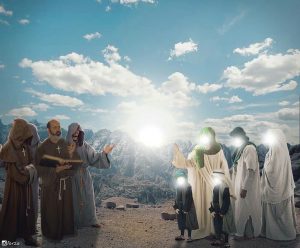
Mubahala – Cursing Contradiction?
Mubahala (Arabic: مُبَاهَلَة, romanized: mubāhala, lit. ‘mutual cursing‘) was an aborted attempt to resolve a theological dispute between Muslims and Christians in 632 AD by invoking the curse of God upon the liars. These debates allegedly took place in Medina, between a Christian delegation from Najran, and the Islamic prophet Muhammad. He proposed this solution probably when their discourse had reached a deadlock concerning the nature of Jesus.
The Christian delegation withdrew from the challenge and negotiated a peace treaty that included the payment of the Dhimmi tax. This episode has been linked to certain verses of the Quran, the central religious text of Islam, particularly verse 3:61. The event is particularly significant for Shia Muslims because Muhammad was accompanied by his daughter Fatima, her husband Ali, and their two sons, Hasan and Husayn, who are pivotal to Shia beliefs. At the time, this event must have raised their religious rank as the partners of Muhammad in his prophetic claims.
Sunni Muslims do not typically celebrate Eid al-Mubahala as a formal, annual religious festival. While Sunnis acknowledge and respect the historical event of Mubahala—this specific day is primarily commemorated and celebrated as an annual Eid within Shia Islam. It takes place annually on 21, or 24 Dhu’l-Hijja of the Islamic calendar.
———————————————–
There are several problems with the Muslim view:
Surah 3:61 (the Verse of Mubahala) may not refer to the divine challenge made to the Christian delegation of Najran: a mutual invocation of God’s curse upon the liar because:
– The Seerah and Hadith, which refer to this incident, emerged 200 years after the alleged event. Where is the contemporary and corroborative evidence from a non-Muslim source for this?
– Muqatil ibn Sulayman, the earliest tafsir commentator, judged by Muslim scholars as being of mixed reliability, is also dated late. It comes from the 8th century AD. That is about 100 years after the supposed events have taken place. He too linked the verse with that story.
-The most complete early copies of the Quran are the Topkapi manuscript (mid-8th century) and the Samarkand Kufic Quran (late 8th/early 9th century). The oldest isolated fragments, such as the Birmingham Quran manuscript and Sana’a manuscript, date to the 7th century but contain only a few pages. In light of the fact that Islam became quickly a dominant power, to rely on such late extant manuscripts, makes it unlikely for non-Muslims to accept its content.
At any rate, Christians do not (generally) curse their enemies because Jesus commands his followers to love them, to bless them and to pray for them (Matthew 5:43-44).
Christians have enough evidence to support their faith. There is no need for a cursing contest. Does it not also contradict this teaching found in the Quran (Surah 18:29) and the Bible (Joshua 24:15): Until the day of judgement God, human beings have free will, whether they chose to worship God or not.
Imagine, God would have clearly cursed one side or the other. There would be no more choice as everyone would naturally leave the cursed ones!
Surah 3:59 says: “Indeed, the example of Jesus in the sight of Allah is like that of Adam. He created him from dust, then said to him, “Be!” And he was!”
Christians did not lose the argument as Muslims like to portray it, because Adam and Eve were the first human beings. Therefore, unlike in the case of Jesus, it is not possible that they could have been born in a natural way.
– Jesus is not just unique among all prophets because of the virgin birth. His message and work is also unique Good News!
How about finding out about it by reading it yourself, for example here in about 150 different languages:
For more information click here:
https://christianityexplained.net/category/to/muslims/