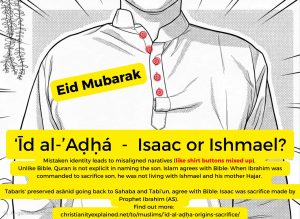
Eid Al Adha Mubarak
The Torah and Injeel are clearly saying that Isaac was the name of the son whom God asked Ibrahim to sacrifice. In his monumental commentary Jami’ al-Bayan, the famous early historian and exegete Ibn Jarir al-Tabari (d. 923 CE) agrees with this Biblical fact. He meticulously preserved the chains of transmission (asānīd) tracking this opinion back to major first-generation figures from among the Companions of the Prophet (Sahaba) and the The Successors (Tabi’un)
For example:
‘Umar ibn al-Khattab: The second Caliph of Islam. Several early reports attribute the view to him.
‘Ali ibn Abi Talib: The fourth Caliph and cousin of the Prophet. Early transmissions note him naming Isaac.
‘Abdullah ibn Mas’ud: One of the earliest converts and a premier authority on the recitation and meanings of the Quran.
Al-Abbas ibn ‘Abd al-Muttalib: The paternal uncle of the Prophet Muhammad.
‘Abdullah ibn ‘Abbas (in some reports): While Ibn ‘Abbas is heavily quoted by later scholars supporting the Ishmael view, classical records show that he actually had conflicting reports transmitted from him, with several early chains firmly aligning him with the Isaac view as well.
Ka’b al-Ahbar (d. 652 CE): A prominent early Yemenite Jew who converted to Islam during the caliphate of ‘Umar
Qatadah ibn Di’amah (d. 735 CE): A legendary early commentator from Basra.
Al-Suddi (d. 745 CE): A major early Kufan exegete.
Masruq ibn al-Ajda’ (d. 682 CE): An influential early scholar and jurist from Kufa who explicitly stated that Isaac was the Dhabih.
Ikrimah (d. 723 CE) & Sa’id ibn Jubayr (d. 714 CE): Both were elite students of Ibn ‘Abbas.
Source in Arabic:
https://quran.com/37:101/tafsirs/ar-tafsir-al-tabari
See also in English: Tabari, V. 2.290, pp. 82-83. https://archive.org/search?tab=all&query=Tabari&and%5B%5D=language%3A%22English%22
The above is also confirmed by Sheikh Yasir Qadhi:
https://youtu.be/CANtmlGngiw?si=ugNNjnO3CqOyemj7
This hadith also confirms the identity of the son as being Isaac:
——————————–
“Muhammad b. al-Muntashir told of a man who vowed to sacrifice himself if God rescued him from his enemy. He consulted Ibn ‘Abbas who told him to consult Masruq, and when he consulted him he replied, “Do not sacrifice yourself, for if you are a believer, you will kill a believing soul, and if you are an infidel you will hasten to hell; but buy a ram and sacrifice it for the poor, for Isaac was better than you and he was ransomed with a ram.”*
He told Ibn ‘Abbas and he replied, “This is the decision I wanted to give you.” Razin transmitted it.
*This agrees with the story in the Old Testament which says that Abraham was preparing to sacrifice Isaac, whereas the usual Muslim version is that it was Ishmael.
———————————-
Source:
Mishkat al-Masabih, 3445
In-Book Reference: Book 15, Hadith 39 https://sunnah.com/mishkat:3445
It is not considered sahih but Miskat al-Masabih is an influential work.
———————————-
The Quran is not explicit in naming the son who was to be sacrificed. Furthermore, Islam based on the Quran and sahih hadith agrees with Torah and Injeel that by the time Ibrahim was commanded to sacrifice his son, he was not living with Ishmael and his mother Hajar.
Muslim objections:
The son to be sacrificed was Ishmael, also because it says in Genesis 22:2:
Then God said, “Take your son, your only son, whom you love—Isaac—and go to the region of Moriah. Sacrifice him there as a burnt offering on a mountain I will show you.”
In their usual ways they only accept what fits into their beliefs, pointing out that “Isaac” must have been inserted later. According to them Ishmael was Abraham’s only son and Isaac was born to him after the test of sacrifice.
They argue that even according to the Bible “your only son” would be wrong since Abraham had two sons at that time.
Christian reply:
There is no textual/manuscript evidence that Isaac is a later insertion.
Ishmael had been sent away BEFORE this event.
Isaac was the son of Promise, born supernaturally, unlike Ishmael. Isaac was thus the UNIQUE son -יְחִֽידְךָ֤ yachid . He is the beloved son – אָהַ֙בְתָּ֙ ahab. John 3.16 – Jesus is the Unique Son; Matthew 3.17
‘And a voice from heaven said, “This is my Son, whom I love; with him I am well pleased.”’
Isaac, like Jesus, was born supernaturally. He was a TYPE of Christ, who was about to be sacrificed, and was symbolically resurrected.
Why is the issue of the identity of the Son to be sacrificed crucial?
– It is a later tradition that Ishmael was the intended sacrificial victim – doubtless because the same Tradition presented him as a forebear, an ancestor of Muhammad.
Source: Seerah of Ibn Ishaq, p. 628. https://archive.org/details/IbnIshaq-SiratuRasulAllah-translatorA.Guillaume
– Unlike the Bible (Hebrews 11:17-19, Genesis 17:15-19,21; 22:1-3,8-14,16-18) the Qur’an presents the event as a test of mere obedience, not of faith. Further, it says nothing about a ram or lamb being substituted – again, this is later tradition.
– Although Ishmael, unlike the sons of Abraham through Keturah, is given special promises, it was Isaac through whom God said the covenant promises would be realised. Only his conception was supernatural.
Sarah was an old, provably barren woman, past the age of child-bearing. Thus, the conception of Isaac was supernatural, typologically forshadowing the supernatural conception of Jesus by the virgin Mary.
Isaac was also typological of Jesus in being the Bearer of the Promise, which is why Jesus is declared the Son of Abraham in Matthew 1.1, and the Seed of Abraham in Gal. 3.16. Neither Ishmael nor the sons of Keturah fell into this category.
Abraham knew that Isaac was supernaturally-generated, and that it was uniquely through Isaac that the Promise of Redemption would be realised. Therefore, if God ordered that Isaac be killed in sacrifice, God would resurrect him to fulfil the Promise.
-The place of sacrifice is emphasised in the Old Testament narrative – Mount Moriah. It later became part of Jerusalem. Jesus says in Luke 13:33:
“In any case, I must press on today and tomorrow and the next day—for surely no prophet can die outside Jerusalem!”
Jesus is the Antitype of Isaac on this sense – the Sacrificial Son, who is the Bearer of the Promise, and who is resurrected.
As a result of the Antitypical event, we have redemption – typologically modelled by the attempted sacrifice of Isaac.
Therefore, for Christians, the Sacrifice of Isaac is not mere history – in terms of its Antitypical significance in the sacrifice of Christ, the Antitypical event saves us from Hell!.
In contrast, the event mentioned in Islam has no contemporary, no covenantal promissory or redemptive significance for Muslims, other than as a model of submission by both Abraham and Ishmael.
Having established the importance of the identity of the sacrifice we will now approach this subject from the perspective of the origins of the term.
ʻĪd al-’Aḍḥá, the Feast of Sacrifice, is the great festival of Islam. It is also known as Baqri-Eid, the Cow Festival. In Egypt and Turkey they call it ‘Idu Bairam. What is the meaning of it? Wise men were saying, “However far the stream flows, it never forgets its source”, and, “Opinion has a significance proportioned to the sources that sustain it”.1
Accordingly, this article will explore the origins of sacrifice in order to fully answer the question under consideration. The concept of sacrifice is also the key that enables the reader to understand the message of the Tawrāt and the Injīl, known as the ‘Holy Bible’. This fascinating theme is found throughout its pages, binding them together with an invisible ‘red thread’ into one unified meaning. Since the Holy Book of the Muslims is “…confirming the scriptures that came before it” (Āl-‘Imrān [3] 3), parallels will be drawn to the concept of sacrifice mentioned in it.2
The word ‘sacrifice’ is defined as, “…a religious rite in which an object is offered to a divinity in order to establish, maintain, or restore a right relationship of a human being to the sacred order. It is a complex phenomenon that has been found in the earliest known forms of worship and in all parts of the world …”.3
According to the Tawrāt, the very first recorded sacrifice to God in the history of mankind was made by Adam’s two sons, Cain and Abel. Muslims know them as Qābil, the elder, and Hābil, the younger, whose sacrifice was accepted by God because he was righteous. What made him right before God? Why did He prefer the sacrifice of the one over the other? Where did this idea of sacrifice come from in the first place? The Quranic account does not tell us. Therefore it is in line with proper academic research to find an answer to that question in the Tawrāt and the Injīl where the same incident was recorded before with additional details:
In the course of time Cain brought some of the fruits of the soil as an offering to the Lord. But Abel brought fat portions from some of the first born of the flock. The LORD looked with favour on Abel and his offering. But on Cain and his offering he did not look with favour … Then the LORD said to Cain: “… If you do what is right, will you not be accepted?” (Genesis 4:3-7)
By faith Abel offered God a better sacrifice than Cain did. By faith he was commended as a righteous man, when God spoke well of his offerings. And by faith he still speaks, even though he is dead. (Hebrews 11:4)
God accepted Abel’s (Hābil’s) sacrifice because it was offered in faith. What was the nature of his faith, on what revelation of God was it based? To answer that question we will first present circumstantial evidence. Both the Tawrāt and the Holy Qur’ān, contain the story of how God created Adam and Eve.4
In Paradise they were allowed to eat from all trees except one. Tempted by Satan they disobeyed God and as a result of this monstrous sin they became aware of their nakedness and covered their shame with leaves. God pronounced a terrible punishment upon them. They and their descendents had to leave Paradise, being unable to continue enjoying a care free life and most of all, a personal relationship with their Creator. The following significant detail is mentioned only in the Tawrāt:
The LORD God made garments of skin for Adam and his wife and clothed them. (Genesis 3:21)
God provided them with clothes made from animal skins to replace their insufficient covering of leaves. Is he illustrating by this that men by themselves are unable to cover their shame caused by sin without the shedding of blood? Did God teach Adam and Eve the concept of sacrifice on this momentous occasion which they then passed on to their children? Two pieces of direct evidence allow us to answer in the affirmative.
Many years after our first parents, God appointed Moses as the leader of the Israelites. He chose them to serve the surrounding nations as an example of who their Creator is, of how to get back into a relationship with Him, and what principles He wanted everyone to live by. At the heart of God’s relationship with His people was an elaborate system of various sacrifices. By way of offering animals they were assured to get their sins forgiven:
The LORD said to Moses and Aaron: “Tell the Israelites to bring you a red heifer without defect or blemish… Give it to Eleazar the Priest; it is to be taken outside the camp and slaughtered…(he) is to take some of its blood on his finger and sprinkle it seven times towards the front of the Tent of Meeting… While he watches, the heifer is to be burned… A man who is clean shall gather up the ashes of the heifer and put them in a ceremonially clean place outside the camp. They shall be kept by the Israelite community for use in the water of cleansing; it is for purification from sin.” (Numbers 19:1-10)
This central requirement of the law is also alluded to in the Qur’ān, Sūrat al-Baqarah [2] 67-74. While Muslim commentators, such as Maududi and Yusuf Ali, link it to Numbers 19:1-10, Ibn Kathir does not. All somewhat disagree among each other as to the meaning of the passage and therefore it is best to go back to the Tawrāt, being the earliest and clearest source, where it was first explained.
Moreover, all Muslim commentators do agree that in Sūrat al-Isrā’ [17] 1-7 the Jewish Temple in Jerusalem is mentioned. It was built in obedience to God’s command. Furthermore, sacrifices for the forgiveness of sins was a vital ritual performed in the temple – the very heart of its existence! Both Muslims and Christians agree that the blood of animals cannot take away sin. All three of God’s books, the Tawrāt, Zabūr and the Injīl, indicate that the sacrifices in the past point to a perfect sacrifice that was to come.5
When God announced the punishment to Shaytan for misleading Adam and Eve, He said in poetic language:
“And I will put enmity between you and the woman, and between your offspring and hers, he will crush your head, and you will strike his heel.” (Genesis 3:15)
Here we find the first of many prophecies by which God announces His plans to bring people back to their original state of a personal relationship with their Maker in Paradise. Incredibly, someone who was to be born of a woman would overcome Shaytan and destroy his power!
In his struggle, the victorious one would have to endure temporary evil inflicted upon him. The following amazing prophecy in the Tawrāt was made about 700 years before its fulfilment. It describes how he, like the animals who were sacrificed before him, would die for the forgiveness of the sins of his people:
But he was pierced for our transgressions, he was crushed for our iniquities; the punishment that brought us peace was upon him, and by his wounds we are healed. We all, like sheep, have gone astray, each of us has turned to his own way; and the LORD has laid on him the iniquity of us all… he was cut off from the land of the living; for the transgression of my people he was stricken.
He was assigned a grave with the wicked, and with the rich in his death, though he had done no violence, nor was any deceit in his mouth. Yet it was the LORD’s will to crush him and cause him to suffer, and though the LORD makes his life a guilt offering, he will see his offspring and prolong his days, and the will of the LORD will prosper in his hand. After the suffering of his soul, he will see the light of life and be satisfied; by his knowledge
My righteous servant will justify many, and he will bear their iniquities. Therefore I will give him a portion among the great, and he will divide the spoils with the strong, because he poured out his life unto death, and was numbered with the transgressors. For he bore the sin of many, and made intercession for the transgressors.” (Isaiah 53:5-12)
In other prophecies that special person was clearly identified as the Messiah (Greek: Christ), a title given uniquely to Jesus in the Qur’ān and in the Bible.6
Jesus Himself confirmed that he was the fulfilment of these prophecies:
He [Jesus] said to them, “This is what I told you while I was still with you: Everything must be fulfilled that is written about me in the Law of Moses, the Prophets and the Psalms.” Then he opened their minds so they could understand the Scriptures. He told them, “This is what is written: ‘The Christ will suffer and rise from the dead on the third day’, and repentance and forgiveness of sins will be preached in his name to all nations, beginning at Jerusalem.” (Luke 24:44ff)
What a profound and wonderful truth: sins are forgiven! God is pleased when we believe in His sacrifice not when we bring our own sacrifice! This truth is foreshadowed in the famous story believed in by Muslims and Christians where Abraham was commanded to kill his son. In Islam the commemoration of it is the basis for ʻĪd al-’Aḍḥá. In the passage that follows we read about God’s miraculous intervention and how He spared the troubled father from this terrible ordeal:
“And We ransomed him with a momentous sacrifice”. (Sūrat as-Saffat [37] 107)
Why is the sacrifice which Muslims, Jews and Christians believe to have been a ram called ‘momentous’, especially when compared with Abraham’s son? Surely he is greater, more important, than a ram! The greatness of this sacrifice cannot be found in its use as a symbol for a human self-purification or devotion, or to commemorate Abraham’s faithfulness. If that was the case, there would be no need for God HIMSELF to provide such a great sacrifice. The answer to the question lies in the word ‘ransom’.
It means that a person, in this case Abraham’s son, is set free in exchange for someone or something else. When compared with Abraham’s son, the ram by itself is not very special; in that sense it is not great. Therefore, the real symbolic importance of it has to lie somewhere else. It points to the perfect sacrifice found in Jesus Christ as mentioned in the Injīl:
Christ was sacrificed once to take away the sins of many people; and he will appear a second time, not to bear sin, but to bring salvation to those who are waiting for him. (Hebrews 9:28)
That truth found again and again in the Holy Bible cannot have been abrogated, otherwise, according to Sūrat al-Baqarah [2] 106, it would have to be replaced with something similar or better. What better could be offered to us than God personally dealing with our sins and with the shame we brought upon Him and ourselves, by supplying a great sacrifice for us in Jesus Christ?!
The literal meaning of the word “Injīl” is “Good News”. Having defeated death, Jesus rose to life again on the third day! Well before He went to heaven, the Messiah said that the way to properly respond to this best news God has ever given to mankind is to repent (meaning: change of mind and heart resulting in turning around from sin) and to simply believe that Jesus died for our sins.
Once a person trusts in what Jesus did and said, through the power of the Holy Spirit God will produce in them assurance of forgiveness instead of uncertainty, joy instead of sadness, selfless love and forgiveness instead of selfish hatred and fear.
To live in such a sacrificial way in thankful response to God giving us eternal life with Him comes at a high price. Followers of Jesus are told in the Holy Bible to be ready to suffer through persecution, by surrendering all of their life to God and His will. But surely it is only right to give to God what we can not keep anyway in order to win what we cannot lose!
If you would like to give your life to the real Jesus described in the Bible, or if you have comments/questions, please contact the publisher at:
info@christianityexplained.net
1 The former is a Nigerian proverb, the latter is a quote from Benjamin Cardozo, US jurist; Supreme Court justice from 1932-38.
2 The words‚ “sacrifice(s)” / “offering(s)” are found 1047 times in the Holy Bible and 16 times in the Holy Qur’ān.
3 http://www.britannica.com/eb/article-9109492/sacrifice
4 Sūrat al-Baqarah [2] 30-39, Sūrat al-A‘rāf [7] 19-25, Genesis 1:25-3:24. All Bible references are taken from Holy Bible (NIV), Hodder & Stoughton, London, 1986.
5 Leviticus 23:19-27: ‘atonement’ from root: ‘to cover’, Psalm 22, Mark 10:45, Hebrews 9:13-14, 10:1-4.